
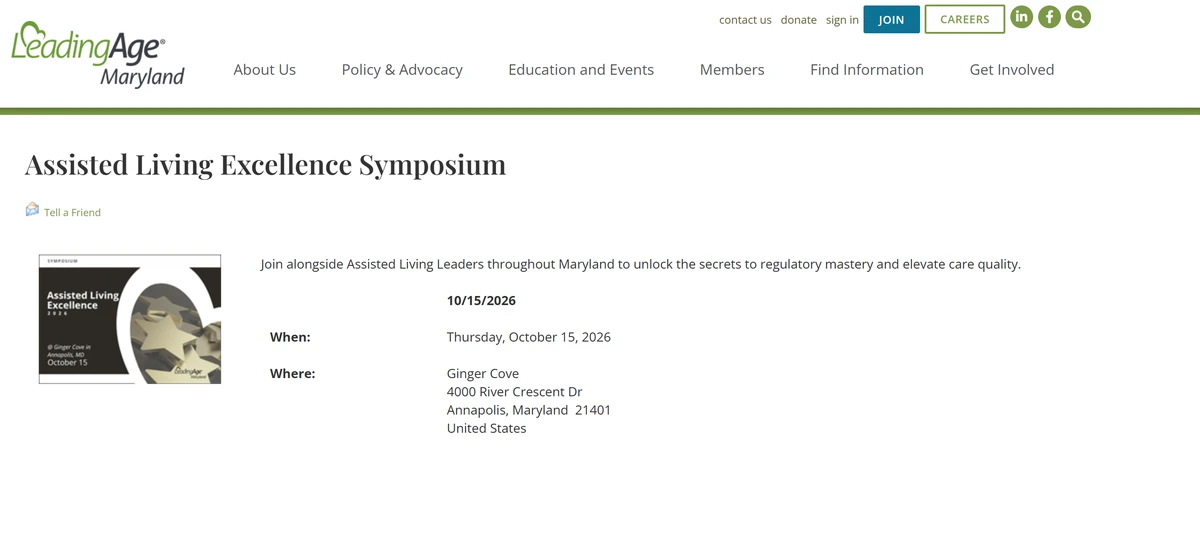
Purpose
I attended this symposium to understand more about the industry, specifically the issues it is facing. Based on my online research and the events I had been attending, I was beginning to understand that documentation is an issue.
Nurses, assisted living owners and healthcare workers with 20 to 30 years in the industry said the same thing. However, I still didn’t understand why. With this event, I was there to validate what I learned from my first workshop and the industry overall.
The event was stacked with decision-makers in the industry. Speakers included:
- Office of Health Care Quality (OHCQ):
- Temi Okpebho, Deputy Director of State Programs
- Jessica Brent, Program Manager for Assisted Living
- Malissa Thiess, Nursing Instructor
- Dr. Rachel Jordan, Director of Advocacy and Legislative Affairs at Hospice of the Chesapeake and Secretary of the Maryland Board of Nursing
Other speakers were Malcolm Frazier of Frazier Alzheimer’s & Dementia Consulting and Erin Cassell of Sobar.
What I Learned
Less time for documentation
Nurses are extremely busy, and the majority of their scope is care, whether for patients or residents. Some staff are older and even struggle to use a computer, let alone keep up with documentation. For them, one could mandate writing it down as a fallback, but this is simply not feasible.
Dr. Jordan explained that most care staff do get their work done but simply don’t have the time to document it. As we will see, this has implications for the business in the form of citations.
Smaller homes feel this the hardest. They get cited more, and they don’t have the personnel to do some of the care requirements, let alone focus on documentation. Some nurses at larger communities handle 2 to 3 roles. It is impossible to picture what this is like in smaller communities.
The recurring split is 60% documentation and 40% care.
Apart from the impact on the business, this problem also affects the nurses themselves.
In about 3 to 4 cases, nurses faced disciplinary action from the Board of Nursing because the documentation showing they were compliant wasn’t available.
Neglect may not have happened at all, but because it wasn’t documented, there is no proof.
For both expected and unexpected state surveys, documentation is the only proof that the work was done.
Most citations are paperwork problems
OHCQ shared its most frequently cited assisted living deficiencies for FY26. Staff qualifications topped the list, followed by emergency preparedness (OHCQ, 2026).
Staff qualifications also show how the bar is moving. Self-attestation is no longer accepted as proof of a staff member’s health screenings, and the grace period for immunity records ends November 1, 2026 (OHCQ, 2026).
While some of these require physical interventions from people, like emergency drills or resident care, the majority are problems that technology, specifically AI systems, is built to solve. From compliance monitoring to medication records and the plan of correction, the senior care industry can and should begin to benefit from this.
Surveys are rising in Maryland
Renewal surveys of assisted living programs rose from 816 in FY25 to 1,564 in FY26. Complaints and self-reported incidents rose from 1,010 in FY22 to 2,267 in FY26 (OHCQ, 2026).
The state of Maryland has been able to ramp up hiring, so OHCQ is completing more surveys, following up on more complaints and conducting more inspections. But OHCQ is still short-staffed, and every inspection costs taxpayers money.
Proof of care
OHCQ wants homes to do the right thing at the right time. I believe its time is best spent on communities that actually neglect their residents, so it can catch neglect cases faster and protect older adults. Records are how it tells neglect apart from care that simply wasn’t written down.
In 2025, the Minnesota Department of Health cleared an assisted living community of a neglect allegation after its records showed the resident received every service in their service plan (Minnesota Department of Health, 2025). Without that proof, well-meaning communities get caught in the middle of enforcement.
The plan of correction is another example. When a home has a complaint or a citation, OHCQ wants it to draft a plan of correction, and that plan needs to be reasonable. Some homes come up with plans they can’t staff, like having someone watch the doors. A plan that isn’t feasible puts the onus on OHCQ to follow up.
That’s why a plan should play to the home’s strengths, such as its staffing. A detailed self-report doesn’t guarantee there won’t be an inspection. If OHCQ follows up, it is to make sure the plan is put in place.
OHCQ Compromises
A draft regulation change would move care notes from weekly to every two weeks, for stable residents only (OHCQ, 2026). For the assisted living owners in the room, this was very welcome.
That being said, I don’t think moving from one week to two will guarantee that people keep up. If staff are stressed in the first week, they will be stressed in the second, and if they fall behind, they now have two weeks of documentation to cover.
The information gap in healthcare
I asked the speakers what a potential solution could look like and what they would like to see. While there is already a huge gap in documentation, the records that do exist are simply not accessible enough. For example, smaller facilities and hospitals don’t feed CRISP. Imagine someone moving from a smaller home to hospice care. Their medical history has to be requested and followed up on manually.
Takeaway
Build the system
Systems are always necessary because they leave less room for failure, and AI systems are perfect for this. I know this because my career has been focused on building these systems and tools for businesses to target problems.
Healthcare is also a business, so being able to accurately track everything about your residents, and understand how that impacts your business, is very useful. What makes it a different business is the level of compliance required, and AI can help keep track of it to protect your business from avoidable citations.
Find the flaw in the system
Even after putting the right systems up, you have to put them to work. Like a car that looks fine on the outside, it can still have oil leaks inside.
Start by looking at where the issue is, whether that’s citations or staffing. With the right data in place, AI systems are great at analyzing and can show exactly where the flaw in your system is.
Contrary to public opinion, applying AI without these systems, or without the data to understand the problem, is the biggest way to fail. Off-the-shelf AI tools still need your business context, and you will need several.
Make the system pay off
Know where you stand to gain
After understanding and fixing the problem, documentation also shows what your business stands to gain. Dr. Jordan explained that an earlier hospice referral gives residents an easier transition. Without it, a resident could be moving in the last 14 days of their life. For the home, it means a resident who stays with you longer. Hospice doesn’t pay for room and board, so the resident keeps paying you for it (Hospice of the Chesapeake, 2026).
The same goes for a wait list: for every resident you can get in earlier, you can forecast what you stand to gain.
Win back the 60%
The business part of care has been neglected for a long time. In an industry like senior care, the care always has to come first. However, the opportunity cost of not engaging with the business is that it doesn’t grow. For the first time, both can go hand in hand.
Spending 60% of work hours on documentation could be replaced with networking with hospitals and other owners, giving that time back to your residents, or even to yourself.